
The sourcing record for barefoot boots sizing tolerance for bulk is incomplete until it supports this Verify samples, materials, print, tolerances, certifications, and bulk-production risk.
Toe-box width needs a tighter tolerance than length on a barefoot boot, because width is the reason the customer bought it.
Buyer summary: For barefoot boots sizing tolerance for bulk, buyers should verify samples, materials, print, tolerances, certifications, and bulk-production risk.
Define the Buyer Decision for Barefoot Boots Sizing Tolerance Checklist for Bulk Orders
Use the supplier's size-tolerance sheet, the approved size-set sample, and the quotation to decide whether the order can move forward. Add a material and construction feasibility check before sample approval so the measurement method and tolerances match the exact boot construction.
- Compare the supplier's stated length, width, stack, and drop tolerances with the buyer-approved limits for every ordered size. Record the agreed values in the RFQ and sample approval form.
- Ask the supplier to confirm the MOQ that applies to the selected construction, color, and size range. Treat quantity as a quotation input rather than an assumed factory fact.
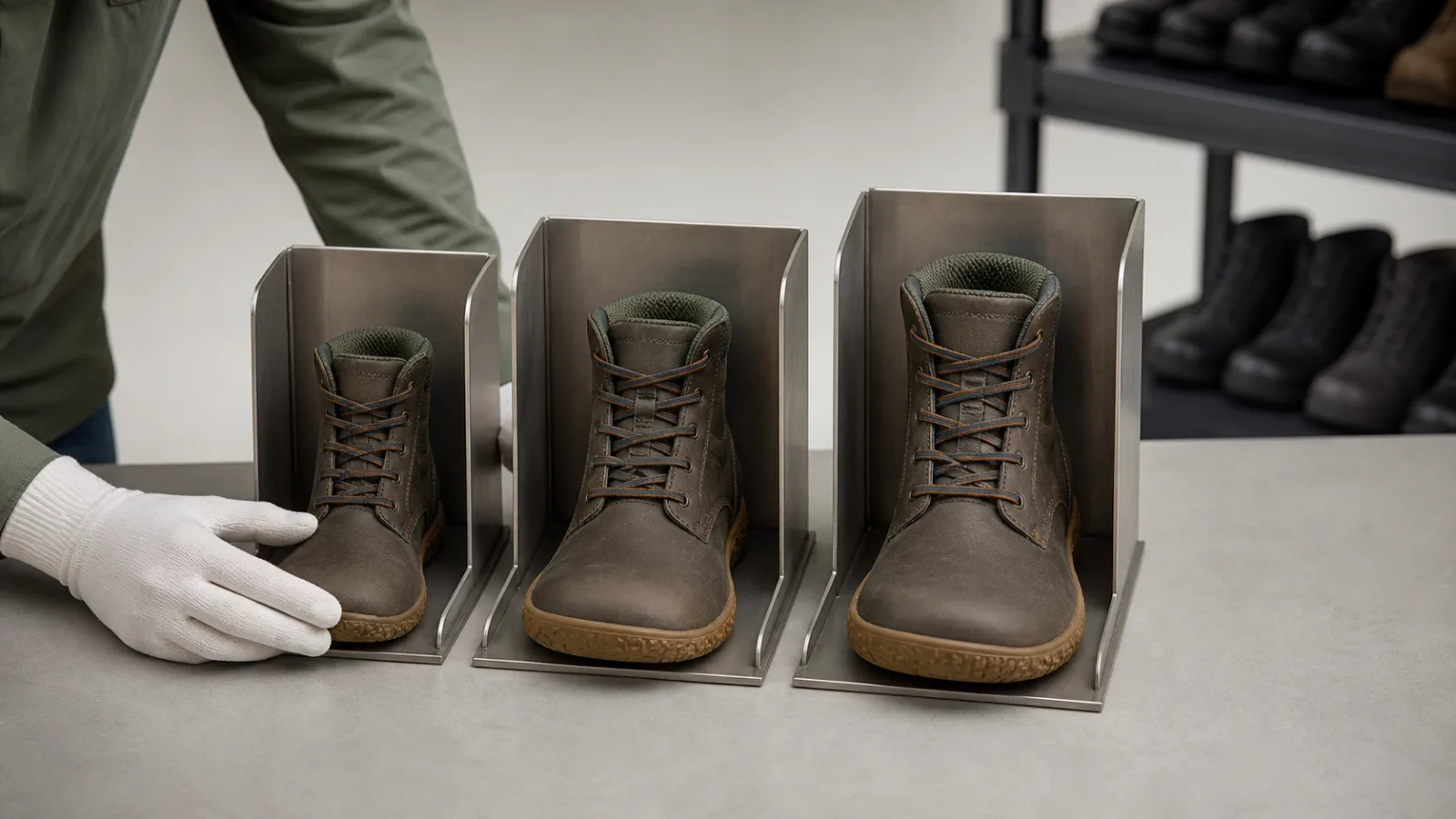
- Measurement evidence: Require a size-set report that names the measurement points, tools, actual results, and tolerance limits. Keep the signed report and approved samples as the bulk-inspection reference.
- The risk is that Flag each result outside the approved tolerance and require a written disposition before bulk release. Unresolved sizing deviations can lead to rework, shipment delay, or fit-related returns.
- Shortlist only suppliers that confirm the measurement method, commercial terms, and correction process in writing before the purchase order.
Confirm Product and Order Scope
For barefoot shoe manufacturing for indie brands boots sizing, use a release rule: approve only when the supplier evidence matches the written requirement.
- Sizing tolerance matches agreed specification for barefoot boot last and zero-drop platform. Supplier-issued dimensional inspection report for first article and each production lot. Supplier quality department or third-party lab. Out-of-tolerance boots cause fit returns, brand damage, and chargeback deductions. Require signed inspection report before sample approval and bulk shipment release.
- Supplier has documented inline QC checks for length, width, and toe-box height on every production batch. QC checklist with pass/fail records for last 3 production runs of barefoot boots. Supplier production or quality manager. Missing inline checks allow defect accumulation, leading to rejected containers or rework delays. Request QC checklist template and last-run records during supplier qualification.
- Approval risk is documented in a written sample sign-off protocol before bulk production begins. Sample approval form with buyer signature and date, plus deviation log if any. Supplier sample room and buyer representative. Verbal approvals cause scope creep, disputed tolerances, and delayed delivery. Establish a two-party sign-off step in the purchase order terms.
Material and specification fit
Verify that the barefoot boot upper, lining, and outsole materials match the agreed specification sheet. Request a material declaration or supplier test report for each component. A mismatch in stack height or zero-drop construction can alter fit and performance. Confirm material thickness and flexibility against your design brief before sample development.
MOQ, cost structure, and lead time
Confirm the MOQ per style and color for custom barefoot boots, typically 500 pairs per color per style. Request a cost breakdown covering tooling, sample, and bulk unit prices. Lead time for custom production ranges from 30 to 45 calendar days after sample approval. Document these terms in the quote to avoid mid-order surprises.
Supplier reliability and quality checks
Assess the supplier's track record with barefoot boot bulk orders. Request references or case studies from similar projects. Verify that the factory holds ISO 9001 certification and conducts inline QC for sizing tolerances. A supplier with documented quality processes reduces the risk of fit-related returns and reorders.
RFQ checkpoint
Ask B2B buyers to share product category, target quantity, market, timeline, and reference files for a practical quote.
Build the Verification Checklist
- Supplier cannot document a dedicated barefoot boot last or sizing block. Without a specific last, bulk boots may drift from zero-drop geometry and wide toe-box specs, causing end-buyer returns. Ask the supplier to share the last specification sheet and confirm it matches your approved sample dimensions. Last drawing or measurement report showing toe-box width and heel-to-toe drop. Add last verification to the sample approval gate before bulk production.
- Supplier rejects inline measurement checks during bulk production. Unchecked sizing tolerance across 500+ pairs per style can produce a batch that fails your fit guarantee. Insist on a mid-production inspection at the cutting and lasting stages, not just final packing. Inspection schedule with checkpoints and pass/fail criteria for each production lot. Write the inspection schedule into the purchase order as a condition of release.
- Supplier has no record of prior bulk orders for barefoot boots from a barefoot shoes manufacturer. Inexperience with zero-drop construction often leads to sole bonding errors or incorrect toe spring. Request references from at least two buyers who ordered similar barefoot boot styles in bulk. Contact details and order volumes from past barefoot boot clients. Call one reference to confirm on-time delivery and sizing consistency.
- Supplier cannot provide a signed approval record for the first sample. Without a written sign-off, the bulk run has no baseline to compare against, risking dimensional drift. Require a written sample approval form that lists all critical measurements and tolerances. Signed sample approval document with date, measurements, and buyer signature. Hold the deposit until the signed approval record is returned.
Compare Quote and Production Assumptions
The main failure mode for custom barefoot shoe development boots sizing is approval before the supplier has resolved the listed evidence gaps.
- What verification method does the factory use to check sizing tolerance during production? A supplier's capability is only as reliable as its inspection process; manual checks can miss drift that automated measuring catches. Factory uses a calibrated 3D footbed scanner on every 50th pair and logs results in a traceable QC record. Without a documented verification method, sizing drift can go undetected until the entire batch is packed and shipped. Ask for a copy of the factory's in-line sizing inspection SOP and the calibration certificate for their measuring equipment.
- What is the approval risk if the sample's sizing tolerance is approved without a written sign-off on the measurement method? Verbal approval leaves room for the factory to use a different gauge or interpretation during bulk production, causing deviation. Supplier requires a signed approval document that specifies the exact measurement points and acceptable tolerance range. Without written approval on method, the buyer has no contractual basis to reject a bulk run that still meets the sample's numbers but was measured differently. Draft a one-page tolerance approval form that both parties sign before sample sign-off, referencing the measurement tool and points.
- What buyer follow-up action ensures the supplier's sizing tolerance capability is maintained for the full order? A single good sample does not guarantee consistent production across thousands of pairs; ongoing checks are needed. Supplier agrees to a mid-production inspection where the buyer or third party measures 50 random pairs for tolerance compliance. Without a follow-up checkpoint, the buyer may discover sizing drift only at final inspection, delaying shipment and causing restocking fees. Schedule a mid-production tolerance check in the purchase order terms, and confirm the inspection protocol before production starts.
Run the Review Before Approval
Open the Define the Buyer Decision for Barefoot Boots Sizing Tolerance Checklist for Bulk Orders review with evidence that the supplier has submitted a signed RFQ confirmation listing the agreed sizing tolerance range. Without this document, do not proceed to sample approval or production release.
Questions to send back to the supplier
- What specific dimension on the boot last does your measurement procedure check, and how does it relate to the buyer’s stated fit requirement?
- Can you provide a written procedure showing how your QC team measures that dimension, including the tool used and the acceptable deviation range?
- If a production batch shows a dimension outside the agreed tolerance, what is your documented rework or rejection protocol?
When to revise, escalate, or reject
Use the following decision framework to classify supplier responses. Each row corresponds to a common evidence gap that must be closed before approval.
| Evidence gap | Buyer action |
|---|---|
| Supplier cannot document a dedicated barefoot boot last measurement step in their QC checklist | Revise: request a written measurement procedure within supplier-confirmed timing |
| Supplier provides a measurement range that does not match the RFQ-confirmed requirement | Escalate: ask for a corrected RFQ confirmation signed by both parties |
| Supplier states they use a generic shoe tolerance without barefoot-specific adjustments | Reject: do not approve; require a barefoot-specific tolerance addendum |
| Supplier has no documented rework or rejection protocol for out-of-tolerance boots | Reject: require a written protocol before any bulk production |
After the supplier resolves all evidence gaps, update the quote request confirmation with the agreed measurement procedure and tolerance range. Only then proceed to sample handoff. Annie works with B2B barefoot shoe buyers on OEM, ODM, private-label, sample, and bulk production orders; Keytop Barefoot Shoes is a Jinjiang-based B2B barefoot shoe OEM/ODM manufacturer focused on meeting buyer-specific sizing requirements through documented QC processes. For more on building a verification checklist, see our Keytop barefoot shoe factory.
Move from Review to RFQ or Sample
The most common failure mode at this gate is proceeding to an quote request or sample request without documented proof that the supplier has matched your sizing tolerance requirement. The control is a simple release rule: approve the buyer follow-up only when the supplier has answered a specific verification question in writing.
Inputs to include in the next message
- State your required sizing tolerance in a single sentence, for example: ‘All barefoot boots must have a length tolerance of the buyer-approved tolerance on the last.’
- Ask the supplier to confirm that they can meet that tolerance and to describe their measurement method (e.g., digital caliper on finished sole).
- Request a sample inspection report that lists the actual measured values for each size in the order.
Ownership and sign-off for the next gate
Assign one person on your team to own the quote request or sample handoff. That person must collect the supplier’s written confirmation and the sample report before releasing the purchase order. The table below shows the minimum checks to complete before moving forward.
| Check | What to verify |
|---|---|
| Supplier confirmation | Written statement that tolerance is achievable |
| Measurement method | Description of how tolerance is measured |
| Sample report | Actual values for each size in the order |
| Sign-off | One person confirms all checks are complete |
After these checks, you can confidently issue the quote request or request samples. The supplier’s answers become part of your order documentation and reduce production risk.
Source check: ISO 9001 quality management standard; Shoe Sample Approval Checklist Before Bulk Production; Lead Time, Shipment Inspection, and Packaging Checklist for Bul….
In conclusion
The sourcing choice for barefoot boots bulk orders comes down to how thoroughly you compare each supplier’s sizing tolerance specification against your own zero-drop and wide-toe-box requirements, then verify that evidence with documented sample approvals and signed measurement reports. Before you approve any quote request or sample request, confirm that the supplier’s MOQ and cost structure align with your order volume, and that their stated lead time matches your production schedule. Document every check—from the initial specification sheet to the final size-run sample—so you have a clear record of what was agreed and what was delivered.
Shortlist only those suppliers who provide full size-run samples and pass your tolerance checks without requiring you to lower your standards. Assign one person on your team to own the quote request or sample handoff, ensuring that all evidence gaps are resolved before moving forward. By following this checklist, you reduce the risk of receiving boots that deviate from your sizing requirements, protect your brand’s fit reputation, and build a repeatable process for future bulk orders.
Barefoot Boots Sizing Tolerance Checklist for Bulk Orders FAQ
What should buyers confirm first?
First, check the supplier’s sizing tolerance specification sheet against your barefoot boot requirements: zero-drop (0mm) and stack height (6–8mm). For custom production, confirm the MOQ of 500 pairs per color per style; for stock styles, 50–100 pairs. Request a sample to verify measurement consistency and document the approved size range. Approving the wrong structure or supplier proof can create quality, cost, or delivery problems.
Which proof should be retained for approval and reorders?
Retain the approved sample and its signed measurement report showing the tolerance for each size. Also keep the supplier’s documented measurement method. For reorders, compare the production sample against the retained approval sample to verify consistency. Document the approval for future reference. Approving the wrong structure or supplier proof can create quality, cost, or delivery problems.
Which warning signs should stop the order?
Stop the order if the supplier fails to provide a full size run sample, or if the sample measurements deviate from the agreed zero-drop and stack height tolerance. Also halt if the supplier cannot document their measurement method or the lead time exceeds the standard 30–45 days. Do not proceed without sample approval. Approving the wrong structure or supplier proof can create quality, cost, or delivery problems. Ask for a sample, specification confirmation, or QC evidence before approval.
quote request handoff: Ask B2B buyers to share product category, target quantity, market, timeline, and reference files for a practical quote. Send Specs for Review.
Leave a Comment
Ask a sourcing question, add your view, or request follow-up from our team. We keep the form short so it feels natural inside the article page.