
The sourcing record for barefoot boots upper and outsole material is incomplete until it supports this Decide whether Barefoot Boots Upper and Outsole Material Comparison for OEM Buyers fits the use case, specs, MOQ, sample approval path, and supplier quote process.
On a barefoot boot the upper has to insulate while the outsole stays thin. Those two material choices constrain each other far more than in conventional footwear.
Buyer summary: For barefoot boots upper and outsole material, buyers should decide whether Barefoot Boots Upper and Outsole Material Comparison for OEM Buyers fits the use case, specs, MOQ, sample approval path, and supplier quote process.
Define the Buyer Decision for Barefoot Boots Upper Outsole Material Comparison
| Option | Best fit | Trade-off | Risk to avoid | Verification | Follow-up |
|---|---|---|---|---|---|
| Full-grain leather upper + carbon rubber outsole | Durable, premium work boot line with high abrasion resistance | Heavier weight, longer break-in, higher unit cost per pair | Inconsistent leather grade from tanning batch to batch | Request tear strength and thickness data per ISO 3376 | Approve a sealed sample before bulk production |
| Microfiber synthetic upper + blown rubber outsole | Lightweight, flexible barefoot boot for casual or travel use | Lower abrasion resistance, potential stitch pull at flex points | Synthetic may delaminate if adhesive curing is not controlled | Check stitch tear and peel adhesion test results | Request a 72-hour flex test sample |
| Buyer-specified upper/outsole material combination | Brand differentiation through proprietary material or color | MOQ of 500 pairs per color per style, extended lead time | Material may not meet zero-drop tolerances or cause tooling delay | Confirm material data sheet and production feasibility | Sign off on material spec before sample development |
| Standard nylon upper + rubber outsole stock style | Low-risk entry, proven durability, fast lead time | Less premium feel, limited branding options | Minimal; stock inventory may be limited | Check available stock inventory and mixed-size availability | Order a stock sample for fit confirmation |
Evaluate the decision criteria as one decision scope. Use this decision matrix as an approval sequence, not as a supplier claim. For full-grain leather upper + carbon rubber outsole, a poor decision can mean inconsistent leather grade from tanning batch to batch. Request tear strength and thickness data per ISO 3376, then approve a sealed sample before bulk production.
For the full-grain leather upper + carbon rubber outsole checkpoint, keep the supplier response, marked sample, approved specification, quotation, and approval owner under the same revision number. If the evidence conflicts with the approved record, hold the quote, sample, or production release until the deviation is explained in writing. Carry the signed decision record into the purchase order, production handoff, shipment release, and later reorder review so every team works from the same baseline.
Supplier proof to verify
Request a material data sheet (MDS) for each upper and outsole candidate. For leather, ask for the ISO 3376 tear strength report. For synthetics, require a peel adhesion and abrasion test record. Cross-reference the supplier's certificate of compliance for the zero-drop build. Keep the sealed sample and the MDS together as the approval baseline.
Use cases that fit
Full-grain leather suits work-oriented barefoot boots where durability and puncture resistance matter. Microfiber synthetic fits lifestyle or travel boots that need lighter weight and faster drying. The custom option allows a brand to match a specific color or performance requirement. Stock nylon is a safe choice for entry-level orders or filling gaps in a collection.
RFQ and sample checks
In the RFQ, specify the required upper and outsole material type, thickness, and any test standards. For the sample, verify that the material matches the data sheet and that the boot maintains the specified zero-drop measurement. Do not approve bulk production until the sample confirms the material's structural integrity and the footbed flatness.
Confirm Product and Order Scope
| Criteria | Baseline option | Confirmed option | Buyer meaning | Risk to avoid | Follow-up |
|---|---|---|---|---|---|
| Upper material specification | Full-grain leather (1.6–1.8 mm thickness) | Suede or nubuck leather (1.4–1.6 mm thickness) | Full-grain offers higher abrasion resistance for work/hiking boots; suede/nubuck reduces weight and break-in time. | Thinner suede may delaminate at stitch lines under repeated flex; confirm tear strength in your use case. | Request material data sheet with ISO 3377-1 tear strength and ISO 5402 flex resistance values. |
| Outsole compound type | Rubber compound with 60–65 Shore A durometer | Rubber compound with 55–60 Shore A durometer | Harder compound improves wear life on abrasive surfaces; softer compound enhances ground feel and grip on wet terrain. | Harder outsole may reduce traction on smooth floors; softer outsole may wear faster on asphalt. | Specify durometer range in RFQ and request abrasion loss test per ISO 4649 for your target surface. |
| Upper lining material | Cotton canvas lining (breathable, washable) | Synthetic mesh lining (quick-dry, antimicrobial) | Cotton is cost-effective and comfortable for dry climates; synthetic mesh resists odor and dries faster in wet conditions. | Cotton may retain moisture and cause blistering in humid environments; synthetic may abrade thin socks over long wear. | Specify lining type in RFQ and request moisture management test (ISO 11092) for your target climate. |
Evaluate Confirm Product and Order Scope as one decision scope. Use this comparison table as an approval sequence, not as a supplier claim. For upper material specification, a poor decision can mean thinner suede may delaminate at stitch lines under repeated flex; confirm tear strength in your use case. Request written proof and compare it with the approved sample or specification, then request material data sheet with iso 3377-1 tear strength and iso 5402 flex resistance values.
For the upper material specification checkpoint, keep the supplier response, marked sample, approved specification, quotation, and approval owner under the same revision number. If the evidence conflicts with the approved record, hold the quote, sample, or production release until the deviation is explained in writing. Carry the signed decision record into the purchase order, production handoff, shipment release, and later reorder review so every team works from the same baseline.
Decision criteria to confirm
Compare upper and outsole material options against your boot's end use. For a work boot, prioritize full-grain leather with a 60–65 Shore A outsole. For a casual or indoor boot, suede with a softer compound reduces weight. Always request material data sheets and test reports before sample approval.
RFQ details to send
Include upper material grade, outsole durometer, stack height, lining type, and construction method in your RFQ. Specify the target standard (ISO or ASTM) for each test. This avoids rework and ensures the supplier can meet your performance requirements. For custom production, confirm MOQ of 500 pairs per color per style.
Production handoff details
After sample approval, document the approved material specifications in the production order. Include the test report reference and acceptable tolerance ranges. For barefoot boot barefoot shoe OEM and ODM services, verify that the outsole compound batch matches the approved sample before bulk production begins.
quote request checkpoint
Ask B2B buyers to share product category, target quantity, market, timeline, and reference files for a practical quote.
Build the Verification Checklist
Before you approve a sample or sign an quote request, confirm that the factory can deliver on your barefoot shoe product range requirements. Use this ordered checklist to verify specs, cost, production risk, and execution readiness.
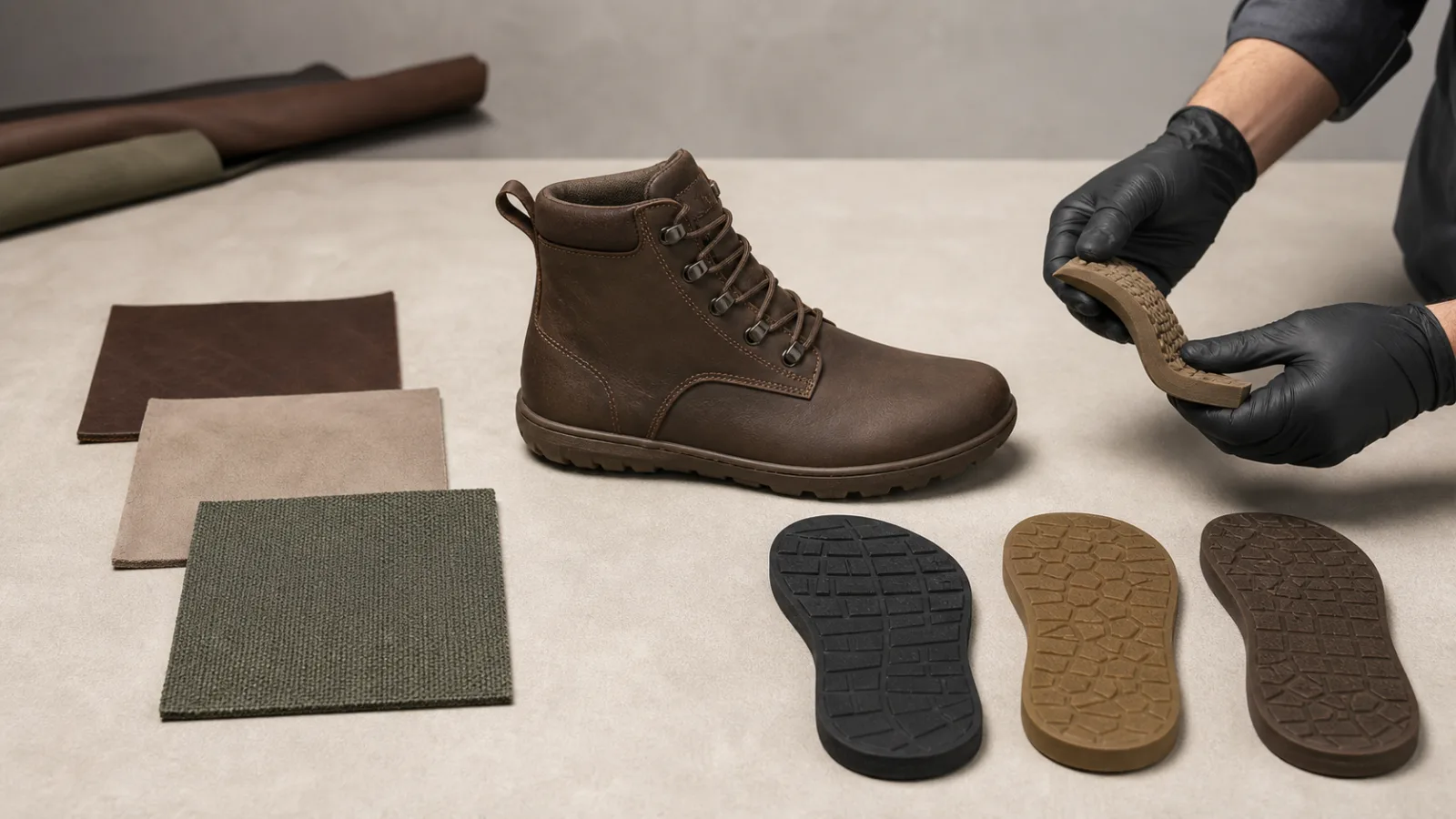
- Confirm material specs with a physical swatch. Request a swatch of the proposed upper (e.g., microfiber, canvas, or leather) and outsole (e.g., rubber, EVA, or TPU). Measure thickness and flexibility against your design brief. Reject any factory that cannot provide a swatch within supplier-confirmed timing.
- Verify outsole abrasion and slip resistance. Ask the factory for their in-house test results for abrasion (e.g., DIN or Taber) and slip resistance (e.g., wet surface coefficient). If they cannot share data, request a third-party lab report at your cost.
- Check minimum order flexibility per material. Ask: “What is the minimum order quantity for this specific upper material and outsole compound?” If the minimum order exceeds your forecast, negotiate a split order or confirm a price break for higher volumes.
- Assess production risk for material sourcing. Inquire whether the upper and outsole materials are in stock or made-to-order. If made-to-order, ask for the lead time and whether the factory holds buffer inventory for common materials.
- Review sample handoff and approval process. Confirm the number of sample rounds included in the quote request (typically 1–3) and the timeline for each round. Require a written approval form before bulk production begins.
After completing the checklist, use the table below to compare material options side by side. This table is designed for quote request-level decisions, not final engineering.
| Material Type | Verification Question | Cost Impact | Production Risk |
|---|---|---|---|
| Microfiber upper | Can you provide a swatch with confirmed thickness and tear strength? | Medium – higher than canvas, lower than leather | Low – widely available |
| Canvas upper | What is the abrasion resistance (cycles) per your test? | Low – most economical | Medium – may require coating for durability |
| Rubber outsole | What is the Shore A hardness and wet slip coefficient? | Medium – varies by compound | Low – standard process |
| EVA outsole | What is the compression set after agreed response time? | Low – lightweight option | Medium – may wear faster than rubber |
Once you have verified each item on the checklist and compared materials in the table, you are ready to proceed to the sample stage. The next section will guide you through evaluating sample quality against your approved criteria.
Compare Quote and Production Assumptions
Use a material and construction feasibility check to confirm that the quoted upper, outsole, geometry, and production route match the intended selling environment. An unresolved substitution or measurement assumption can invalidate the sample comparison.
Supplier evidence to request
Request applicable material data and evidence of a comparable barefoot shoe manufacturing for indie brands. The supplier should identify the proposed source, material grade, and any allowed substitution rather than making a generic durability claim.
Sample approval evidence
Compare flexibility, grip, abrasion exposure, care requirements, and climate against the buyer's intended use. Confirm the decision with an approved sample and written acceptance criteria instead of assuming one compound works for every market.
Reorder control records
Ask the factory to confirm sourcing assumptions, minimum order, quote exclusions, measurement points, and the process for approving a deviation. Retain the marked specification and sample report before bulk release.
| Checkpoint | Buyer verification question |
|---|---|
| Material identity | Which data sheet and supplier reference apply to the quoted upper and outsole? |
| Construction geometry | How will stack and drop targets be checked against the approved sample? |
| Production consistency | Which incoming and in-process records will identify a material substitution or batch change? |
| Sample handoff | Which assumptions must be signed off before the same route is released for bulk production? |
Attach these answers to the quote request comparison and hold approval until each unresolved assumption has an owner and buyer follow-up.
Run the Review Before Approval
Before you approve a sample or sign an quote request, confirm that the factory can deliver on your upper and outsole material requirements. This checkpoint ensures that every specification is verified, costed, and risk-assessed before production begins.
Questions to send back to the supplier
- What is the confirmed material stack for the upper (e.g., mesh, leather, synthetic) and outsole (e.g., rubber compound, EVA)?
- What is the supplier’s verified thickness range for each layer, and how does it affect the barefoot flexibility and ground feel?
- What is the confirmed outsole hardness (Shore A) and how does it compare to your target for zero-drop performance?
- What is the minimum order per material type and color, and what are the cost implications if you need a custom blend or thickness?
- What is the supplier’s defect rate for the proposed materials, and what is their process for replacing defective batches?
When to revise, escalate, or reject
If the supplier cannot provide verified material data (e.g., thickness, hardness, composition) within two business days, escalate to a technical review. Revise the specification if the proposed outsole compound is harder than your requirement, as this compromises Keytop barefoot shoe factory function. Reject the sample if the upper material shows visible inconsistency in texture or thickness across the sample pair, as this indicates poor production control.
Use this decision matrix as an approval sequence, not as a supplier scorecard:
| Checkpoint | Pass Criteria | Fail Action |
|---|---|---|
| Material data verified | Supplier provides documented thickness and hardness within agreed response time | Escalate to technical review |
| Outsole hardness matches target | Shore A within your specified range | Revise specification or reject |
| Upper material consistency | No visible variation across sample pair | Reject sample |
| MOQ and cost alignment | MOQ and per-unit cost within your budget | Renegotiate or escalate |
| Defect rate and replacement process | Supplier states acceptable defect rate and clear replacement terms | Revise contract terms |
After passing all checkpoints, proceed to quote request confirmation and sample handoff. Document every decision in your approval record to avoid disputes during bulk production.
Move from Review to RFQ or Sample
Before you approve a sample or sign an quote request, confirm that the factory can deliver on your upper and outsole material requirements. A verified measurement record—such as a durometer test of the outsole compound or a thickness gauge report for the upper—makes the decision verifiable. Keytop Barefoot Shoes, a Jinjiang-based B2B barefoot shoe OEM/ODM manufacturer, provides these records as standard during the quote request handoff.
Inputs to include in the next message
- Specification sheet: Include material type, thickness, and hardness values (e.g., Shore A for outsole, mm for upper).
- Cost or minimum order range: State your target unit price and minimum order quantity to filter factories.
- Production risk note: Flag any known issues (e.g., outsole adhesion with thin rubber, upper tearing at stitch lines).
- Factory execution evidence: Request a sample of the same material combination from a recent production run.
Ownership and sign-off for the next gate
Assign one decision-maker to approve the quote request or sample request. This person must confirm that the factory’s material specs match your requirements before moving forward. Use the table below as a checklist.
| Gate | Owner | Sign-off criteria |
|---|---|---|
| RFQ submission | Procurement lead | Spec sheet and cost range approved |
| Sample request | Product manager | Material test records reviewed |
| Sample approval | Quality engineer | Physical sample matches spec |
Once the sample passes, proceed to bulk production with a signed quote request. This structured handoff reduces rework and ensures material consistency.
Source check: ISO 2859-1 sampling inspection standard; Footwear Raw Materials Supplier Guide: Source from Top Chinese…; OEM Industrial Footwear Sourcing: A Neutral Guide for Southeast….
In conclusion
The sourcing choice between upper and outsole materials for barefoot boots ultimately comes down to how each option affects your specification compliance, cost structure, and production risk. Before you shortlist a supplier, validate the spec by cross-referencing the stack height and zero-drop requirement against the material data sheet for both the upper and outsole. Compare options by documenting the minimum order and lead time implications of each material pair, then check the factory’s ability to deliver consistent adhesion and flex performance at scale. Approve a sample only after the sealed material specification sheet matches your approved quote request fields, and stop the order if the supplier cannot provide a material data sheet for the outsole compound or upper construction. This structured approval sequence keeps procurement decisions grounded in measurable factory proof rather than marketing claims.
To request a quote for barefoot boots upper, use barefoot boots to confirm the final specification, quote assumptions, sample approval, QC evidence, approval risk, and supplier follow-up before bulk order.
Barefoot Boots Upper Outsole Material Comparison FAQ
What should buyers confirm first?
First, verify the barefoot boot’s stack height and zero-drop specification against your target market. For OEM buyers, the upper material (e.g., leather, microfiber, or mesh) and outsole rubber compound directly affect cost and minimum order. Check that the supplier can document the exact upper thickness and outsole hardness (Shore A) in the quote request, and confirm the minimum order quantity for custom material combinations, which typically starts at 500 pairs per color per style. Ask how QC will check the sample, color, finish, packing, and bulk order.
Which proof should be retained for approval and reorders?
Retain a signed material specification sheet and a sealed sample that matches the approved upper and outsole composition. This proof should include the supplier’s documented test results for abrasion resistance and flexing durability. For reorders, require the same material batch reference or a new pre-production sample to confirm consistency, and store the original sample as a visual and tactile benchmark.
Which warning signs should stop the order?
Stop the order if the supplier cannot provide a material data sheet for the upper or outsole, or if the sample shows visible delamination, uneven thickness, or a Shore A hardness outside the agreed range. Also flag any verbal promise of a lower minimum order without written confirmation, as this often leads to production delays or material substitution. Always request a QC check on the first shipment to verify the outsole adhesion and upper stitching before bulk payment.
quote request handoff: Ask B2B buyers to share product category, target quantity, market, timeline, and reference files for a practical quote. Send Specs for Review.
Leave a Comment
Ask a sourcing question, add your view, or request follow-up from our team. We keep the form short so it feels natural inside the article page.