
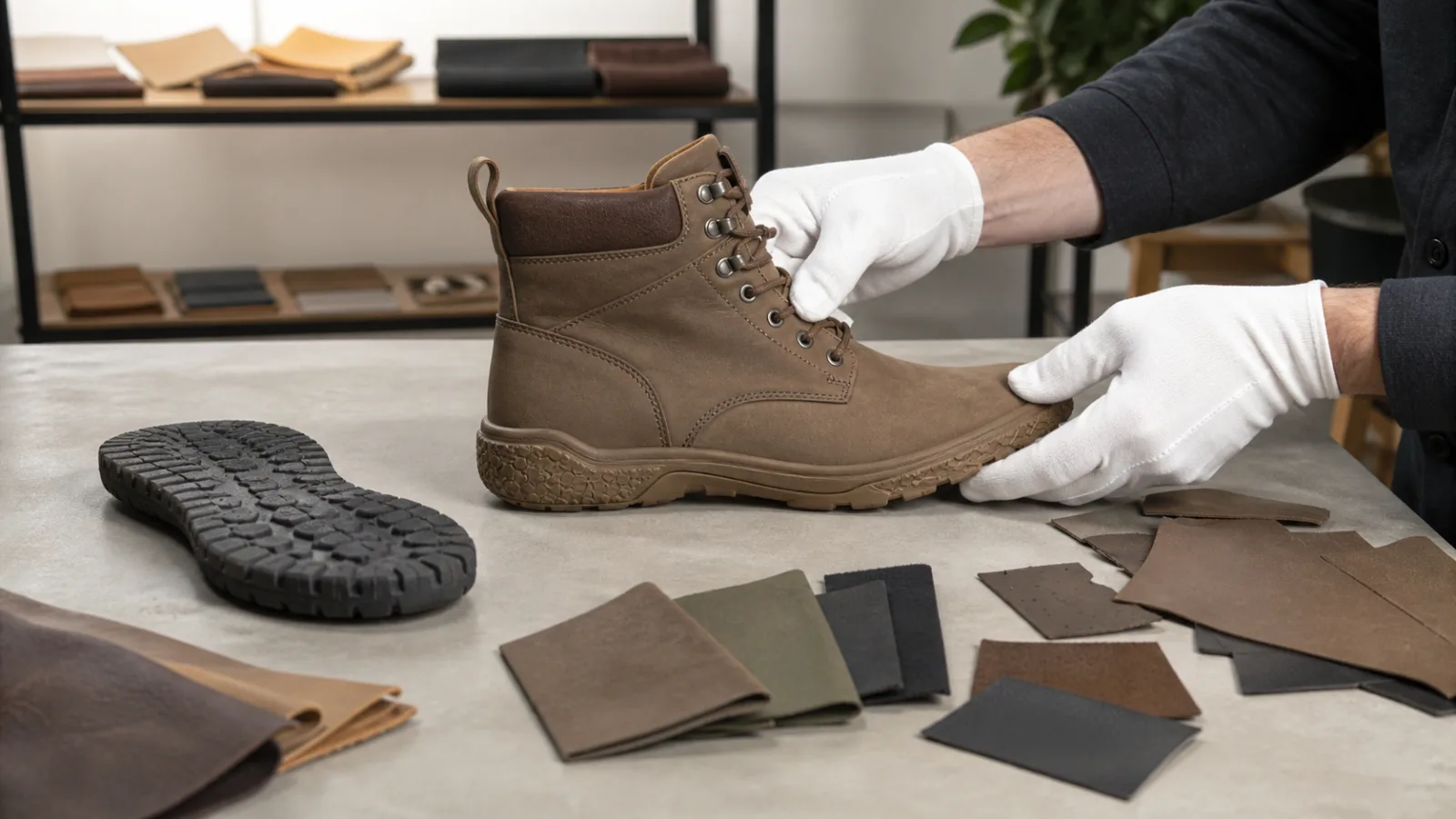
The sourcing record for barefoot boots supplier audit is incomplete until it supports this Shortlist Barefoot Boots Supplier Audit Checklist suppliers using proof, capability, quality, MOQ, and delivery criteria.
Most boot factories can build one barefoot boot; fewer can hold the sole thickness consistent across a full run. The audit should test for the second thing.
Buyer summary: For barefoot boots supplier audit, buyers should shortlist Barefoot Boots Supplier Audit Checklist suppliers using proof, capability, quality, MOQ, and delivery criteria.
Define the Buyer Decision for Barefoot Boots Supplier Audit Checklist
Compare the decision criteria for barefoot boots supplier against one RFQ revision. Each row should identify the requirement, approval evidence, and buyer action before production.
| Requirement | Factory control | Evidence to verify | Order risk | RFQ follow-up |
|---|---|---|---|---|
| Sample approval | Lock written sample approval before bulk production starts. | Compare the sample with the tech pack and approved measurements. | Production can drift when no approved reference sample is recorded. | Attach the signed sample record to the purchase order. |
| MOQ and order quantity | Confirm MOQ by model, color, size run, and customization level. | Request separate quantity rules for stock and custom production. | A blended MOQ can hide color or size minimums and surcharges. | State quantity per model, color, and size run in the RFQ. |
| Material / substrate | Record material grade, construction, color, and approved substitution rules. | Match supplier documents and the physical sample to the specification. | Unapproved substitutions can change fit, durability, appearance, or compliance. | List material requirements and substitution limits in the RFQ. |
| Width or size tolerance | Record nominal dimensions and the tolerance accepted for production. | Measure the sample at agreed checkpoints with the stated method. | Unclear tolerance can create fit disputes and inconsistent size grading. | Add measurement points, tolerance, and approval owner to the tech pack. |
For barefoot boots supplier, use the decision criteria as the decision scope. Read the rows as one approval sequence. Start with sample approval; use the risk and buyer-action columns to decide whether its evidence is sufficient. Verify it with the inspection method and approval evidence recorded in the table.
For this barefoot boots supplier sourcing record, keep the supplier response, marked sample, and approval owner under the same revision number. If any proof conflicts with the approved record, hold the quote, sample, or production release until the supplier explains the deviation in writing. Before closing the checkpoint, reconcile the latest drawing, sample, quotation, and approval comments, identify which record controls if they disagree, and document the resolution. Carry the signed the decision criteria table into the purchase order and production handoff so the same checks support quote comparison, sample approval, shipment release, and later reorders.
Questions to confirm before ordering:
- What is the factory's verified zero-drop and stack-height tolerance for barefoot boots? Barefoot boot buyers require exact 0mm drop and a stack height between 6-8mm. A supplier that cannot hold these specs during production will compromise the foot-health claim of your brand. The supplier provides a written spec sheet with measured tolerance per production batch and can show a sample-room gauge check during your audit. Accepting a verbal assurance without documented tolerance data risks shipping boots that are technically not barefoot, leading to returns and brand reputation damage. Request the factory's internal spec card for your chosen barefoot boot style and compare it against the sample you approve before bulk production.
- Does the supplier have an in-house QC gate for checking sole adhesion and upper stitching on zero-drop boots? Barefoot boots have a thinner sole construction than conventional boots, making sole separation and stitch failure more likely if QC checks are not adapted to the lower stack height. The audit shows a dedicated QC station with a pull-test fixture for sole adhesion and a stitch-count checklist for the upper, with records from the last three production runs. Without a specific barefoot-boot QC gate, the factory may apply standard boot inspection criteria that miss delamination or weak stitching unique to thin-sole construction. Ask to see the QC checklist used for the last barefoot boot order and confirm the pull-test force threshold matches your agreed specification.
- Can the factory provide a material origin and thickness report for the outsole and insole used in barefoot boots? The ground feel and flexibility of a barefoot boot depend on outsole rubber compound and insole thickness. A supplier that sources generic materials may produce a boot that feels stiff or has uneven wear. The supplier shares a material declaration sheet with outsole durometer reading and insole thickness measurement, traceable to their incoming inspection log. Using unverified materials can result in boots that do not flex at the metatarsal or that wear out prematurely, increasing your warranty claims and return rate. During the audit, collect a material sample from the current stock and compare it against the declaration sheet; file both for your production approval record.
- What is the supplier's process for confirming the wide-toe-box last shape before cutting? Barefoot boots require a toe-box that allows natural toe splay. If the factory uses a standard boot last, the finished product will pinch toes and fail the barefoot fit promise. The supplier shows a last-measurement record for your style, with width and toe-box height data, and a sign-off step before the cutting department begins. Skipping last confirmation can lead to a full production run of boots that are too narrow, forcing you to discount inventory or redo the order at your cost. Request a last-measurement photo and dimension log for your style before sample approval, and include a fit-test clause in your sample sign-off form.
Confirm Product and Order Scope
| Option | Best fit | Trade-off | Risk to avoid | Verification | Follow-up |
|---|---|---|---|---|---|
| Current specification match | Supplier's existing barefoot boot upper and sole compound match your RFQ exactly. | No material or construction changes needed, but limits design differentiation. | Accepting without verifying compound hardness or stitch density may cause sole delamination. | Cross-check supplier spec sheet against your RFQ line items for sole compound and upper material. | Document the matched spec in a signed sample approval form before sampling. |
| Alternative specification adjustment | Supplier offers a similar barefoot boot with one material swap, such as a different outsole rubber. | Faster sample turnaround than full custom, but may alter flex or grip performance. | Unverified alternative may not meet your target stack height or zero-drop tolerance. | Request a material data sheet and a wear-test sample of the alternative compound. | Compare the alternative spec against your RFQ and approve only after wear-test review. |
| Custom option development | Full OEM or ODM barefoot boot with buyer-selected upper, sole, and branding. | Longer development cycle and higher minimum commitment per style and color. | Without a written specification checkpoint, the sample may deviate from your design intent. | Require a detailed spec sheet and a pre-production sample approval gate before bulk. | Issue a finalized RFQ with sole compound, upper material, and stitch density locked. |
| Safer fallback stock style | Supplier's in-stock barefoot shoe product range that meets your basic zero-drop and wide-toe requirements. | Limited color and size options, but no tooling cost and fastest delivery. | Stock styles may lack the exact stack height or material you need for your target market. | Confirm inventory availability and request a physical sample of the stock style. | If stock fits your spec, proceed with a sample order and bulk confirmation. |
Evaluate product and order scope as one approval sequence rather than treating a catalogue match as proof. Cross-check the supplier specification sheet against each RFQ line item, keep the marked sample and quotation under one revision number, and hold approval when the records conflict.
Material and specification fit
Compare the requested sole compound, upper material, construction details, and tolerances with the supplier's written capability response. Ask for applicable material data and a construction feasibility check before authorizing sample development.
MOQ, cost structure, and lead time
Ask the supplier to quote the applicable MOQ, sample and tooling charges, payment milestones, and lead-time assumptions for the exact specification. Record each term in the RFQ comparison instead of relying on unverified benchmark numbers.
Supplier reliability and quality checks
Request evidence relevant to the buyer's compliance program, together with a written sample-approval record and named QC owner. Check the document scope and validity rather than assuming that a particular certification applies to every supplier or material.
quote request checkpoint
Ask B2B buyers to share product category, target quantity, market, timeline, and reference files for a practical quote.
Build the Verification Checklist
At this process checkpoint, you must have a finalized quote request that specifies sole compound, upper material, and stitch density. Before proceeding to sample handoff, confirm each requirement with a buyer verification question.
- Specs: Does the supplier provide a material data sheet for the rubber compound and a stitch-per-inch count for the upper?
- Cost or minimum order: What is the per-pair cost at the agreed minimum order, and does it include outsole tooling amortization?
- Production risk: Can the factory show a documented quality control plan for sole adhesion and seam strength?
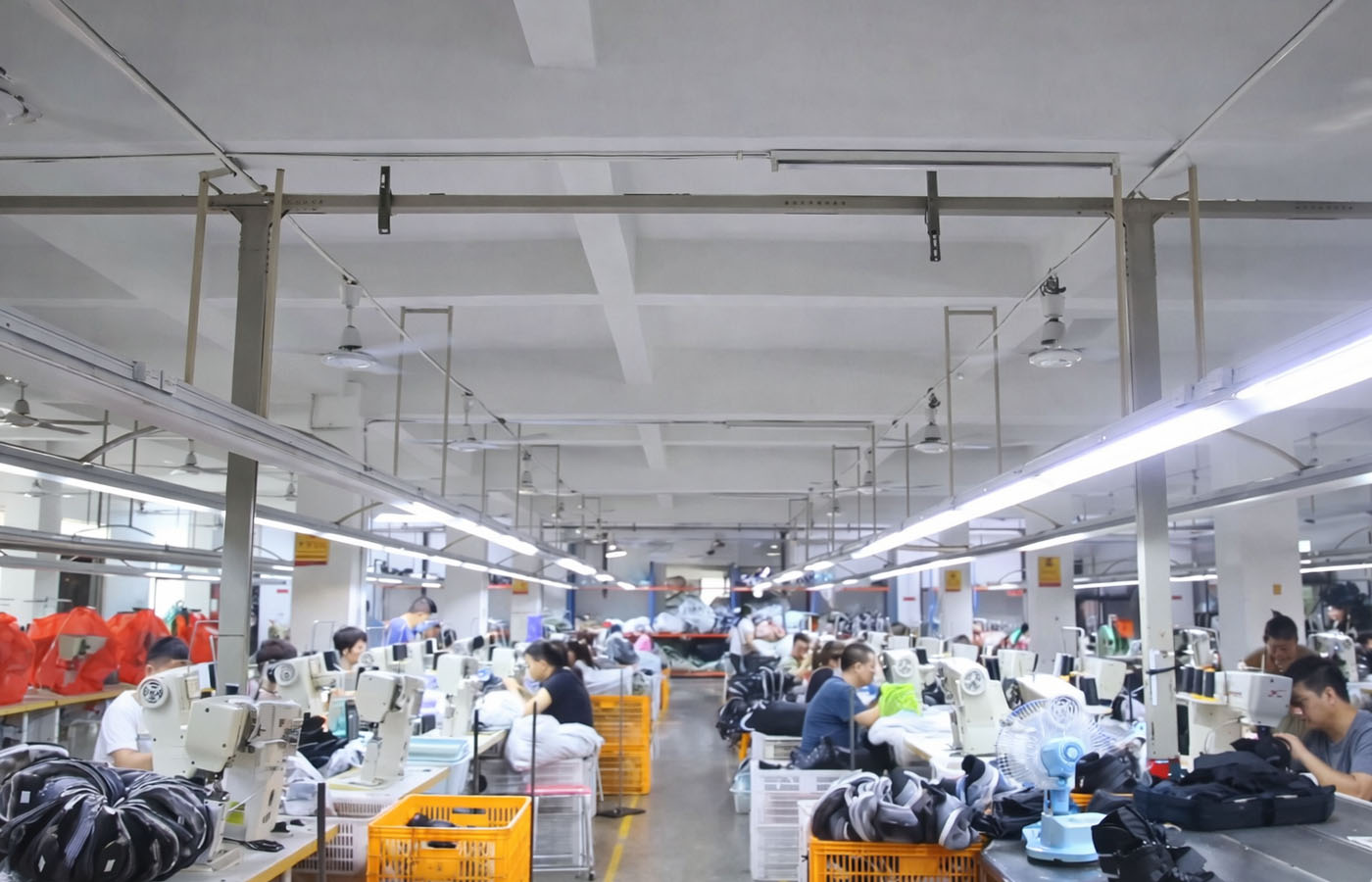
- Factory execution: Request a video walkthrough of the assembly line showing the lasting and outsole bonding stations.
- quote request/sample handoff: Require a signed quote request confirmation that lists each spec, the unit price, and the sample delivery date.
Use the table below to cross-check casual barefoot shoes responses against your quote request.
| Requirement | Buyer Verification Question | Supplier Response |
|---|---|---|
| Sole compound | What is the durometer and abrasion index? | |
| Upper material | Is the leather full-grain or split, and what is the thickness? | |
| Stitch density | What is the minimum stitches per inch on the vamp? |
After the supplier completes the table, proceed to sample approval. Do not move to bulk production without a signed quote request confirmation and a passed first-article inspection.
Compare Quote and Production Assumptions
Build the barefoot boots supplier quote request around Confirm sole compound, upper material, and stitch density match the quote request specification sheet. Match every listed buyer input to written supplier confirmation, approval evidence, and the risk that would hold the quote.
- Confirm sole compound, upper material, and stitch density match the quote request specification sheet. A mismatch between the quote and the actual spec can lead to rejected samples or production delays. For custom barefoot shoe development, verify the stack height and zero-drop tolerance are written into the supplier's confirmation. You may receive boots with incorrect flexibility or durability, requiring costly rework. Compare the supplier's written specification against the buyer-confirmed requirement before sample approval.
- Require a SKU-specific minimum order in the supplier's written quotation rather than a general range. A vague minimum order can hide per-color or per-style minimums that inflate your total commitment. The quote should state the exact pairs per color per style, not a blanket number covering all variants. You might be forced to order excess inventory or pay penalties for under-ordering. Ask the supplier to itemize minimum order by SKU and confirm it matches the quoted quantity.
- Document the production timeline from sample approval to shipment, including buffer for material sourcing. Lead time directly affects your go-to-market schedule and cash flow planning. For a custom order, the supplier should state the number of calendar days after deposit and sample sign-off. Unexpected delays can cause missed retail windows or contractual penalties. Verify the supplier's written timeline against the buyer-confirmed requirement and lock it in the quote.
- Identify which line items drive the unit price: material grade, tooling amortization, or labor complexity. Knowing the cost driver helps you negotiate or substitute without sacrificing quality. If the quote shows a high tooling fee, ask if it can be spread across multiple reorders. You may approve a quote that becomes uncompetitive after the first run. Request a cost breakdown and compare it against the quoted quantity to spot hidden charges.
- Schedule a written confirmation call after quote receipt to clarify assumptions and approval gates. Verbal agreements are not enforceable; written follow-up ensures both parties are aligned. Confirm the supplier's account manager will send an updated quote with all changes within two business days. Misunderstandings about payment terms or delivery dates can stall production. Send a follow-up email summarizing the agreed points and request a signed quote revision.
- Define the inspection points: in-process, final random, and pre-shipment check against the approved sample. Without defined QC gates, defects may go undetected until the container arrives. The supplier should confirm they will hold a final inspection at the factory before loading. You could receive boots with sole delamination or stitching flaws that are not covered by warranty. Include the QC plan in the quote and require a signed inspection report before shipment.
Run the Review Before Approval
Before approval, confirm that the quote request locks the sole compound, upper material, construction details, tolerances, and sample acceptance criteria. The supplier response should state the sample sequence, commercial assumptions, and owner for each unresolved point.
Send the following verification questions back to the supplier and retain the answers with the approved revision.
Questions to send back to the supplier
- Can you confirm the sole compound and provide the material specification used for the quotation?
- Which tooling, sampling, material, packing, and production charges are included or excluded?
- How will stitch density and other construction tolerances be checked during production?
- What are the sample handoff milestones, approval owners, and conditions for moving to bulk production?
- How will the factory document and approve any material or construction substitution?
When to revise, escalate, or reject
Use the decision record below to determine the buyer follow-up.
| Response | Buyer action |
|---|---|
| Sole compound or construction detail not confirmed | Revise the RFQ or escalate for technical review. |
| Cost inclusions and exclusions remain unclear | Request a revised quotation before comparison. |
| Verification method is not documented | Request a written procedure and sample acceptance record. |
| Sample schedule has no milestones or approval owner | Hold approval and require a complete handoff plan. |
If the response does not meet an quote request requirement, do not approve the sample by assumption. Revisit the requirement or consult the barefoot shoe manufacturing for indie brands before the next commitment.
Move from Review to RFQ or Sample
A confirmed quote request that includes the sole compound, upper material, and stitch density requirement serves as the verifiable record that moves the audit from review to quote request or sample. Without these three specifications documented and agreed upon, the review cannot proceed to the next gate.
Inputs to include in the next message
- Confirmed upper material type and source (e.g., leather, synthetic, or recycled).
- Sole compound hardness and composition (e.g., rubber hardness level).
- Stitch density requirement (e.g., stitches per inch specification).
- Packaging and labeling standards.
- Quality control sampling plan (e.g., number of samples per production run).
- Payment terms and delivery schedule.
Ownership and sign-off for the next gate
The buyer’s procurement lead and the supplier’s account manager jointly sign off on the quote request before sample production begins. At Keytop barefoot shoe factory Shoes, Annie works with buyers to ensure the quote request matches the audit findings, providing a clear handoff to sampling.
The following table outlines the key requirements that must be verified before moving to the next gate.
| Requirement | Verification Method | Owner |
|---|---|---|
| Upper material confirmed | Supplier provides material datasheet | Buyer’s procurement lead |
| Sole compound hardness | Submit compound sample for testing | Supplier’s R&D team |
| Stitch density | Sewing machine setting and inspection | Quality control manager |
| Packaging standards | Submit packaging mockup | Buyer’s logistics team |
Once all criteria are met, the quote request is signed off and sampling can begin.
Source check: ISO 2859-1 sampling inspection standard; Supplier Audit Checklist for First-Time Buyers; How do I confirm stock availability for footwear before paying?….
In conclusion
The sourcing choice for barefoot boots comes down to how thoroughly you compare each supplier’s specification sheet, cost structure, and minimum order against your own order requirements. By verifying the sole compound, upper material, and stitch density before the quote request is signed off, you reduce the risk of a mismatch that could delay sampling or inflate per-unit cost. Document every approval step—from the initial spec match to the signed sample approval—so that both you and the supplier have a clear record of what was agreed. This disciplined approach lets you shortlist a supplier who can deliver consistent quality at a predictable lead time, and it sets the stage for a smooth handoff from quote request to sample development.
To compare options for this order, use barefoot boots to confirm the final specification, quote assumptions, sample approval, QC evidence, approval risk, and supplier follow-up before bulk order.
Barefoot Boots Supplier Audit Checklist FAQ
What should buyers confirm first?
Buyers should first confirm that the supplier’s barefoot boot specification matches the quote request, including zero-drop sole, stack height (6-8mm for barefoot boots), and wide toe-box construction. Verify the minimum order for custom production is 500 pairs per color per style, and request a lead time estimate for base-model samples (7-14 days) or full OEM samples (10-21 days) to assess feasibility. Approving the wrong structure or supplier proof can create quality, cost, or delivery problems.
Which proof should be retained for approval and reorders?
Retain the signed sample approval document, which confirms the sole compound, upper material, stitch density, and final fit. This proof should also include the supplier’s QC report and photos of the approved sample for reorder consistency, ensuring the same specification is used for bulk production. Approving the wrong structure or supplier proof can create quality, cost, or delivery problems.
Which warning signs should stop the order?
Warning signs include the supplier refusing to provide a written specification for the barefoot boot’s zero-drop measurement or stack height, or being unable to share a sample approval timeline. Also stop if the supplier cannot document their QC process for sole flexibility and toe-box width, as these are critical for barefoot boot performance. Approving the wrong structure or supplier proof can create quality, cost, or delivery problems.
quote request handoff: Ask B2B buyers to share product category, target quantity, market, timeline, and reference files for a practical quote. Send Specs for Review.
Leave a Comment
Ask a sourcing question, add your view, or request follow-up from our team. We keep the form short so it feels natural inside the article page.