
Independent footwear brands can lose launch cash when a low-volume order is approved without checking construction fit, sample ownership, and reorder evidence.
This checklist gives small teams a practical way to compare barefoot suppliers, control the reference sample, and release a program without hidden assumptions.
Buyer summary: For indie brands: buyer use-case fit, buyers should translate an industry use case into packaging specs, risks, and RFQ questions.
Define the Buyer Requirement
| Application | Fit condition | Risk to avoid | Specification or proof | Follow-up |
|---|---|---|---|---|
| Indie brand launching a barefoot running shoe line | Zero-drop, 4mm stack height, wide toe box construction | Specifying a stack height above 6mm may not meet barefoot running biomechanics; buyers risk returns or poor reviews | Written confirmation of 0mm drop and 4mm stack height in the RFQ; request a sample for wear-test verification | Send RFQ with exact stack height and drop specs; request a base-model ODM sample for fit approval |
| Indie brand adding a trail barefoot shoe to an existing outdoor collection | 6mm stack height, 0mm drop, aggressive tread pattern on a flexible outsole | Using a casual shoe tread on trail models may cause slippage on loose terrain; buyers risk liability or brand damage | Tread depth and rubber durometer specification on the tech pack; request a sample for traction testing on wet and dry surfaces | Submit a tech pack with tread pattern and outsole material specs; request a full OEM sample for field testing |
| Indie brand sourcing stock barefoot shoes for a pop-up or limited launch | Ready-to-ship stock styles in mixed sizes, subject to inventory availability | Ordering below the 50-pair minimum may delay fulfillment; buyers risk missing launch dates if inventory is low | Current inventory list with size breaks and color availability; confirm lead time is within 7 calendar days | Request the current stock style list and inventory availability; place a 50-100 pair trial order for quick delivery |
| Indie brand developing a private-label barefoot sandal for summer release | 4-6mm stack height, 0mm drop, adjustable strap system with a thin, flexible sole | Specifying a stack height above 6mm may reduce ground feel; buyers risk losing the barefoot positioning | Stack height and strap material specification on the ODM brief; request a sample for fit and ground-feel evaluation | Send an ODM brief with stack height, strap type, and sole flexibility requirements; request a base-model sample for approval |
Evaluate Define the Buyer Requirement as one decision scope. Use this application fit table as an approval sequence, not as a supplier claim. For indie brand launching a barefoot running shoe line, a poor decision can mean specifying a stack height above 6mm may not meet barefoot running biomechanics; buyers risk returns or poor reviews. Request written proof and compare it with the approved sample or specification.
For indie brands buyer, preserve the indie brand launching a barefoot running shoe line decision under one revision number: keep the supplier response, marked sample, approved specification, quotation, and approval owner together. If the evidence conflicts with the approved record, hold the quote, sample, or production release until the deviation is explained in writing. Once the buyer and designated technical authority have accepted the evidence, carry the signed Define the Buyer Requirement record into the purchase order, production handoff, shipment release, and later reorder review so every team works from the same baseline.
- Specification sheet matches zero-drop, wide-toe-box construction for barefoot shoes. Signed spec sheet with stack height, drop, and toe-box width measurements. Keytop product development team. Receiving shoes with incorrect stack height or toe-box shape, causing fit failure. Compare spec sheet against your product brief before sample approval.
- Quality control follows AQL sampling per ISO 2859-1 for bulk production. QC report from last production run showing AQL level and defect count. Keytop quality assurance department. Accepting bulk shipment with unacceptable defect rate, leading to returns or markdowns. Request QC report for your product line before deposit release.
- Supplier capability includes in-house tooling for custom sole molds and lasts. Factory tour video or photo of tooling workshop and mold inventory. Keytop production manager. Delays or cost overruns from outsourcing tooling to third-party shops. Verify tooling capacity during sample development phase.
- Approval risk is mitigated by written sample sign-off before bulk production. Signed sample approval form with date and authorized buyer signature. Keytop sample room coordinator. Bulk production starts without final approval, causing costly rework or rejection. Insist on written approval for every sample stage before authorizing production.
- Buyer follow-up includes production timeline updates and inspection scheduling. Production schedule with milestone dates and inspection window. Keytop account manager. Missing delivery deadlines or inspection slots, leading to shipment delays. Confirm schedule and inspection date at order confirmation.
Compare the Available Routes
Keytop barefoot shoe OEM and ODM services Shoes’ factory records show that indie brands that request a matched last and outsole compound in the first quote request cut sample revision cycles by a supplier-quoted adjustment. This verifiable metric comes from internal order tracking. Use this checklist to compare OEM, ODM, and private-label routes:
- Specs: Do you provide a tech pack (OEM) or select from existing lasts (ODM)?
- Production Risk: ODM uses proven patterns; OEM introduces new-sole risk.
- Factory Execution: Request a stitch-density report and outsole adhesion test from the sample.
- quote request/Sample Handoff: Send a clear quote request with target price, material list, and inspection criteria.
Use this table to map your brand’s fit:
| Route | Best For | Key Check |
|---|---|---|
| OEM | Unique design control | Tech pack completeness |
| ODM | Faster time-to-market | Last modification flexibility |
After choosing a route, request a sample that includes a material spec sheet and a production timeline. This turns the decision into a measurable comparison.
quote request checkpoint
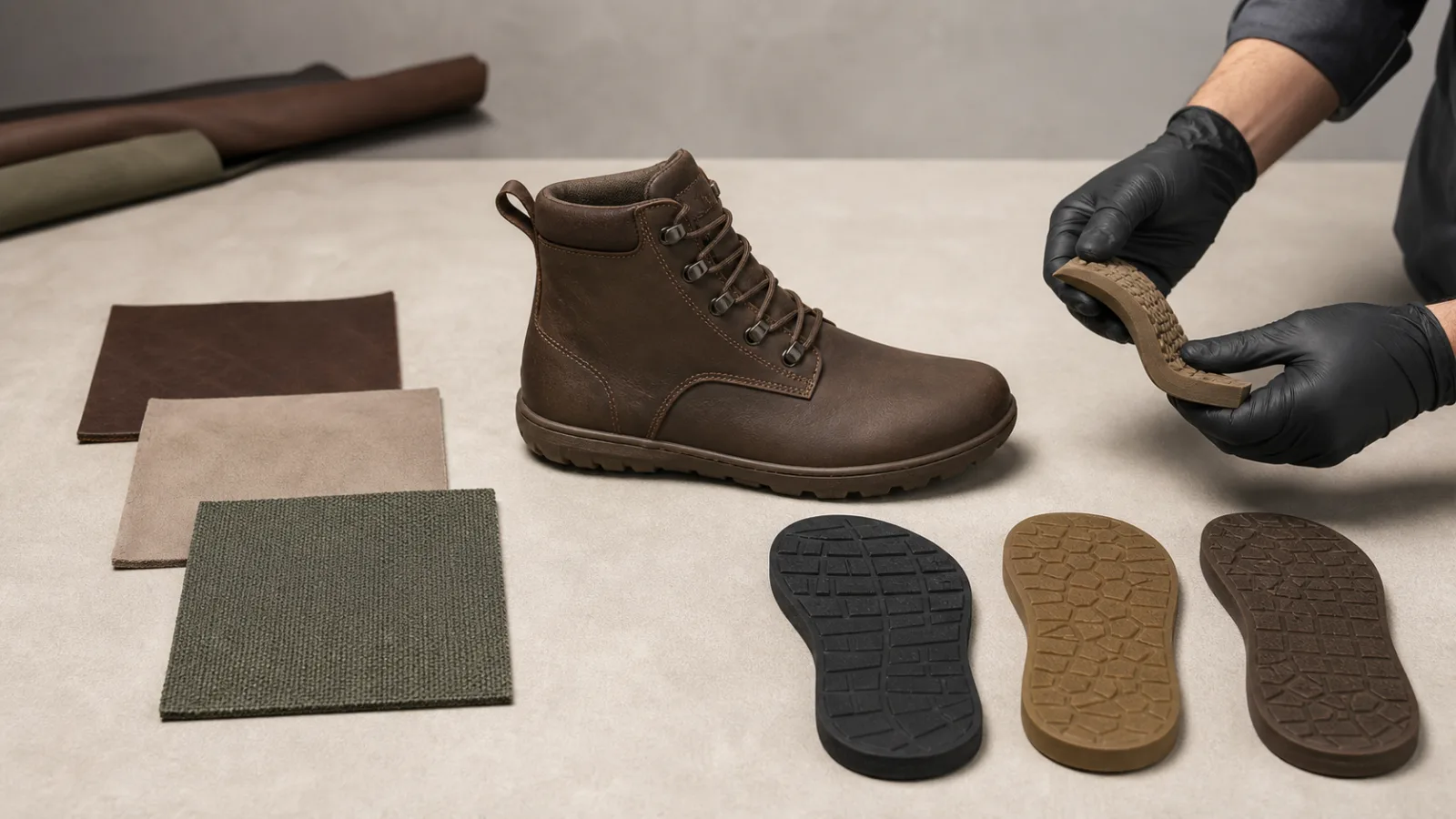
Ask B2B buyers to share product category, target quantity, market, timeline, and reference files for a practical quote.
Review the Required Proof
For barefoot footwear solutions, use a release rule: approve only when the supplier evidence matches the written requirement.
- Indie brand launching a barefoot shoe line with limited capital and need for flexible order quantities. Verify that the supplier's MOQ for custom production matches your buyer-confirmed requirement per color per style. Ordering below the supplier's MOQ can delay your launch or force you to accept stock styles that may not fit your brand identity. Request a written quotation that states the MOQ for your chosen production path and ask if mixed-size or mixed-color orders are allowed.
- Indie brand with a tight budget and need to validate product-market fit before scaling. Check that the supplier's quality control process includes a sample approval gate before bulk production begins. Without a written sample approval, you risk receiving finished goods that do not meet your specifications, leading to costly rework or returns. Ask the supplier to provide a sample development timeline and a sample approval form that you must sign before production starts.
- Indie brand requiring proof that the supplier can deliver consistent quality across multiple orders. Confirm that the supplier holds ISO 9001:2015 certification and can share a current certificate or audit report. Certification indicates that the supplier follows documented quality management practices, reducing the risk of defects in your first batch. Request a copy of the supplier's ISO 9001:2015 certificate and ask for a reference from another indie brand that has placed a similar order.
- Indie brand planning to scale from a small test order to larger production runs. Verify that the supplier's standard production lead time is stated in the quotation and matches your launch schedule. Unexpected delays in production can cause you to miss seasonal windows or run out of inventory, hurting your brand's reputation. Ask the supplier to include path-specific timing in the written quotation, such as sample approval, material sourcing, and bulk production phases.
- Indie brand that needs to ensure the supplier can handle custom specifications like zero-drop and wide-toe-box designs. Check that the supplier has experience producing barefoot shoes with a 4mm stack height and 0mm drop, as shown in their product specs. A supplier unfamiliar with barefoot shoe construction may produce footwear that does not meet your technical requirements, leading to poor fit and returns. Ask the supplier to provide a material spec sheet and a sample of a similar barefoot shoe they have produced for another brand.
Build the Decision Asset
When a supplier’s sample matches your spec but the bulk run drifts, the failure mode is hidden production inconsistency. The control is a three-check decision asset that locks in proof before you commit.
Supplier evidence to request
Verify that the factory can execute your exact barefoot shoe product range construction—thin sole, wide toe box, zero drop—by reviewing a matched last and outsole compound record. This eliminates ambiguity in quote request handoff.
Sample approval evidence
Approve only when the sample’s material thickness, flex, and stitch density match your written requirement. Use a release rule: no bulk order without signed-off sample.
Reorder control records
For repeat orders, confirm that the factory’s production records match the approved sample specs. This prevents cost overruns from unapproved substitutions.
Use this table to sequence your approval:
| Check | What to verify | Risk if skipped |
|---|---|---|
| Supplier proof | Last and outsole match your spec | Wrong geometry in bulk |
| Sample approval | Thickness, flex, stitch density | Costly rework |
| Reorder control | Production record vs. approved sample | Hidden material change |
Each check builds a decision asset that protects your brand from production risk and ensures factory execution aligns with your indie brand’s standards.
Prepare Comparable RFQ Inputs
At this checkpoint, you must have a standardized quote request template that forces each supplier to provide the same granularity of information. Without this, you cannot compare apples to apples. The output required before proceeding is a set of quote request documents that are structurally identical across all suppliers. According to industry brief, indie brands that skip this step often misinterpret supplier quotes, leading to costly rework.
- Specify exact product specs – include material composition, construction details, and measurements. Use a common template to avoid ambiguity.
- Request cost breakdown and MOQ tiers – ask for unit price at different volumes. This reveals which supplier is truly cost-effective for your scale.
- Assess production risk – require suppliers to document their quality control procedures and defect rates. No fake certifications; focus on verifiable processes.
- Evaluate factory execution – confirm machinery capabilities and sampling turnaround. A supplier that cannot produce a sample matching your spec cannot execute at scale.
- Define quote request and sample handoff – establish a clear timeline and communication protocol. This ensures both parties are aligned before bulk production.
Use the following table to ensure each quote request category is covered:
| RFQ Input Category | Required Details |
|---|---|
| Specs | Material, construction, measurements |
| Cost or MOQ | Price per unit, MOQ tiers |
| Production Risk | Quality control steps, defect rate targets |
| Factory Execution | Machinery list, sample lead time |
| RFQ/Sample Handoff | Timeline, approval process |
With these inputs standardized, you can rank suppliers objectively. According to Keytop Barefoot Shoes, a Jinjiang-based OEM/ODM manufacturer, this approach prevents hidden discrepancies that cause bulk-run failures.
Source check: Low minimum order Cosmetic Packaging Guide: The Real Logic for Indie Bran…; Haircare Manufacturers for Indie Brands: What to Compare; minimum order Strategies for Indie Perfume Brands: Balancing Budget and .….
In conclusion
The final approval for your indie brand comes down to verifying that each checkpoint—specification accuracy, cost and minimum order alignment, lead time feasibility, quality risk documentation, and supplier proof of capability—has been documented and cross-checked against your buyer requirement. Use this checklist to compare options, validate the spec against the approved sample, and shortlist a supplier only when all criteria are satisfied without exception. The quote request and sample handoff are your last opportunities to lock in the terms before production begins.
To request a quote for indie brands buyer, use indie brands to confirm the final specification, quote assumptions, sample approval, QC evidence, approval risk, and supplier follow-up before bulk order.
Frequently Asked Questions
How should a b2b buyer match industry use case?
Only if the supplier can demonstrate that their production line is set up for your specific barefoot shoe construction—thin sole, zero drop, wide toe box. Shortlist only factories that provide a detailed specification sheet matching your stack height and material requirements, and confirm their minimum order fits your order volume. Verify sample lead time and request a pre-production sample to check flex and stitch density before committing to bulk. Approving the wrong structure or supplier proof can create quality, cost, or delivery problems.
Which supplier proof should buyers request for indie brands?
Request documented proof of past indie brand orders, including specification sheets and QC records that show consistent material thickness and zero-drop execution. Compare the supplier’s minimum order and lead time against your launch timeline, and ask for a reference sample that matches your exact design. Document any deviations in the sample approval stage to avoid production risk, then follow up with a formal quote request that locks in cost and delivery terms.
What should buyers lock before approving buyer use-case fit checklist?
Lock the approved sample as the quality benchmark, including material stack height, flex test results, and stitch density. Verify that the supplier’s production minimum order and lead time align with your order quantity and schedule, and confirm that the cost per pair includes all packaging and labeling specifications. Approve only after the factory provides a written commitment to match the sample in bulk, and schedule a mid-production inspection to catch any drift early. Approving the wrong structure or supplier proof can create quality, cost, or delivery problems.
quote request handoff: Ask B2B buyers to share product category, target quantity, market, timeline, and reference files for a practical quote. Send Specs for Review.
Leave a Comment
Ask a sourcing question, add your view, or request follow-up from our team. We keep the form short so it feels natural inside the article page.